





From Mechanics to Metrics
In the previous blogs of this series, I have described the app like a theoretical physicist.
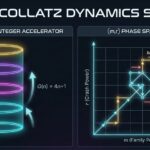
- App 4 (The Periodic Table): We classified the “particles” (integers) into families based on their crash power (r).
- App 5 (The Interferometer): We observed the “mechanics” of how their arithmetic linearity breaks down.
But a theory is nothing without hard data. We know how the numbers crash, but we haven’t asked: How high do they fly before they fall? And how long do they survive?
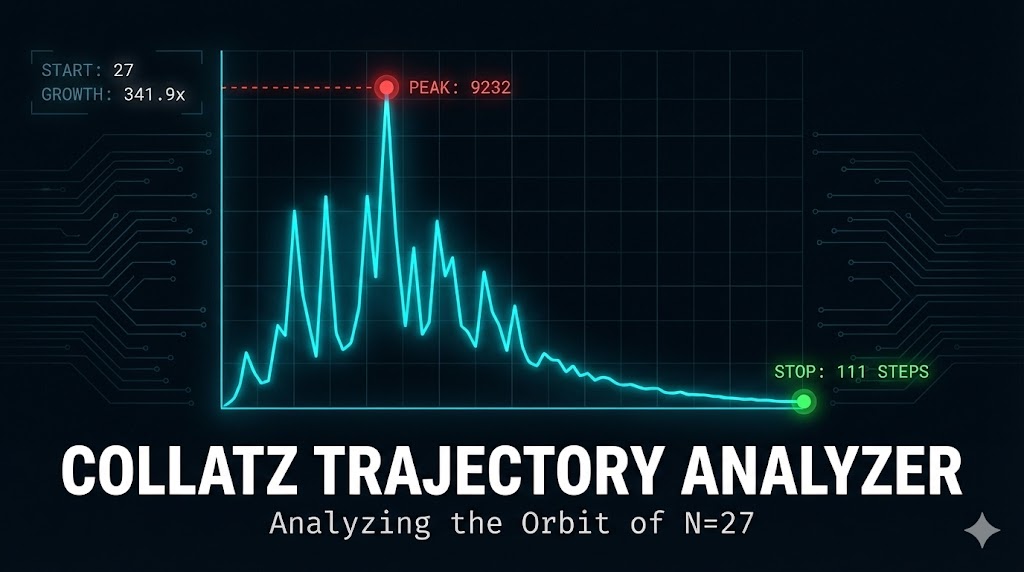
Today, I am releasing App #6: The Collatz Trajectory Analyzer.
This tool is the “Flight Recorder” for the Collatz sequences. It shifts our focus from the structure of the number to the magnitude of its journey.
Part 1: The Altimeter (Peak Analysis)
The first tab of the analyzer is dedicated to Altitude.
When you enter a range of numbers, the tool calculates three critical metrics defined in my research paper:
- Max Peak: The highest value the number reaches. This represents the maximum “potential energy” of the orbit.
- Growth Factor: A measure of volatility. If a number starts at 27 and peaks at 9232, it has a massive Growth Factor. It is a “High Flyer.”
- Glide: This is perhaps the most important metric for researchers. “Glide” is the number of steps an integer stays above its starting value. It measures Resilience. A number with a high Glide is fighting the “gravity” of the Collatz map successfully… for a while.
Part 2: The Chronometer (Stopping Time)
The second tab focuses on Time.
Instead of looking at individual numbers, this tool looks at distributions. You can ask questions like:
- “Which integers have a stopping time of exactly 100 steps?”
- “Is there a pattern to the lifespans of the r=2 family?”
By grouping integers by their Stopping Time, we can see the “Clusters of Chaos”—groups of numbers that, despite being far apart on the number line, share the exact same distance to 1.
Why This Completes the Set
With the release of the Trajectory Analyzer, we now have a complete “Lab Suite” for the Collatz Conjecture:
- The Periodic Table tells us WHAT the number is.
- The Interferometer shows us HOW it moves.
- The Trajectory Analyzer tells us WHERE it goes.
This triad of instruments—Classification, Mechanics, and Statistics—provides a 360-degree view of the problem, verifying the theoretical models proposed in my research.