








In the age of generative AI, where tools can write entire essays in seconds, a paradox has emerged in education: while producing text has never been easier, understanding the craft of writing is at risk of being lost.
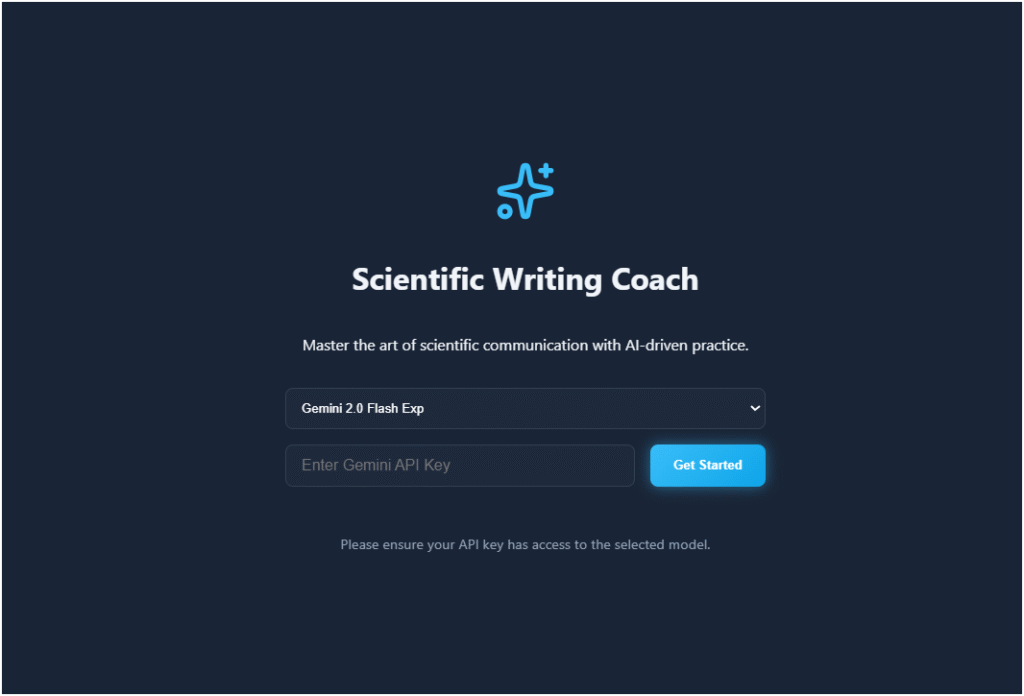
Reflecting on this, I have developed the Scientific Writing Coach—not as a tool to write for you, but as a mentor to think with you.
The Problem with “Auto-Fix”
Traditional writing assistants (like Grammarly or standard spellcheckers) function as editors. They spot an error, suggest a fix, and the user accepts it—often without understanding why the original was weak. This passive loop improves the document, but not the writer.
For scientific writing, which demands precision, neutrality, and rigid structure, this “auto-fix” approach falls short. Students might produce a polished paper but still struggle to structure an argument or interpret p-values in their next study.
The Solution: A Socratic AI Coach
Our new tool hosted on Prayogashaala flips this model. Instead of giving answers, it asks questions.
By integrating Google’s Gemini 2.5 Flash model with a context-aware architecture, the app functions as a rigorous peer reviewer. Here is how it promotes deep learning:
1. Context-Aware Critical Thinking
Unlike generic writing prompts, our app requires the user to upload a research article. The AI reads this specific text and bases its entire coaching session on it.
- The Workflow: It doesn’t ask “What is a hypothesis?”; it asks “In the PDF you uploaded, where does the author explicitly state their hypothesis? Does it align with their conclusion?”
- The Skill: this forces students to actively hunt for evidence, analyze logical flows, and validate their understanding against a real-world example.
2. The Socratic Method
If a student answers a question incorrectly, the AI doesn’t just say “Wrong.” It guides them:
“Not quite. Look at the third paragraph of the Discussion section. Notice how the author discusses the limitations of the sample size. How does that affect the generalizability of their claim?”
This ensures that the student is doing the cognitive heavy lifting.
3. Deconstructing the “Rules” of Science
We broke down scientific writing into 8 core criteria, moving beyond simple grammar:
- Precise & Neutral Language: Learning to strip away emotion (“This amazing result…”) for facts (“The result showed a significant increase…”).
- Statistics & Math Modelling: Teaching students not just to calculate numbers, but to write about them effectively.
- Structure & Flow: Understanding the IMRaD (Introduction, Methods, Results, Discussion) framework.
Data-Driven Self Reflection
Perhaps the most powerful feature is the Comprehensive Report. After a practice session, the app analyzes the entire conversation history to generate a personalized report detailing the user’s specific strengths and weaknesses.
- Are you consistently failing to identify the passive voice?
- Do you struggle to summarize complex methods?
This feedback loop turns practice into measurable progress.

Conclusion
The goal of the Scientific Writing Coach is to use AI to make students better thinkers, not just faster writers. By simulating the back-and-forth of a rigorous academic defense, we prepare students to not only write science but to truly understand it.
Try the tool now at Prayogashaala.com